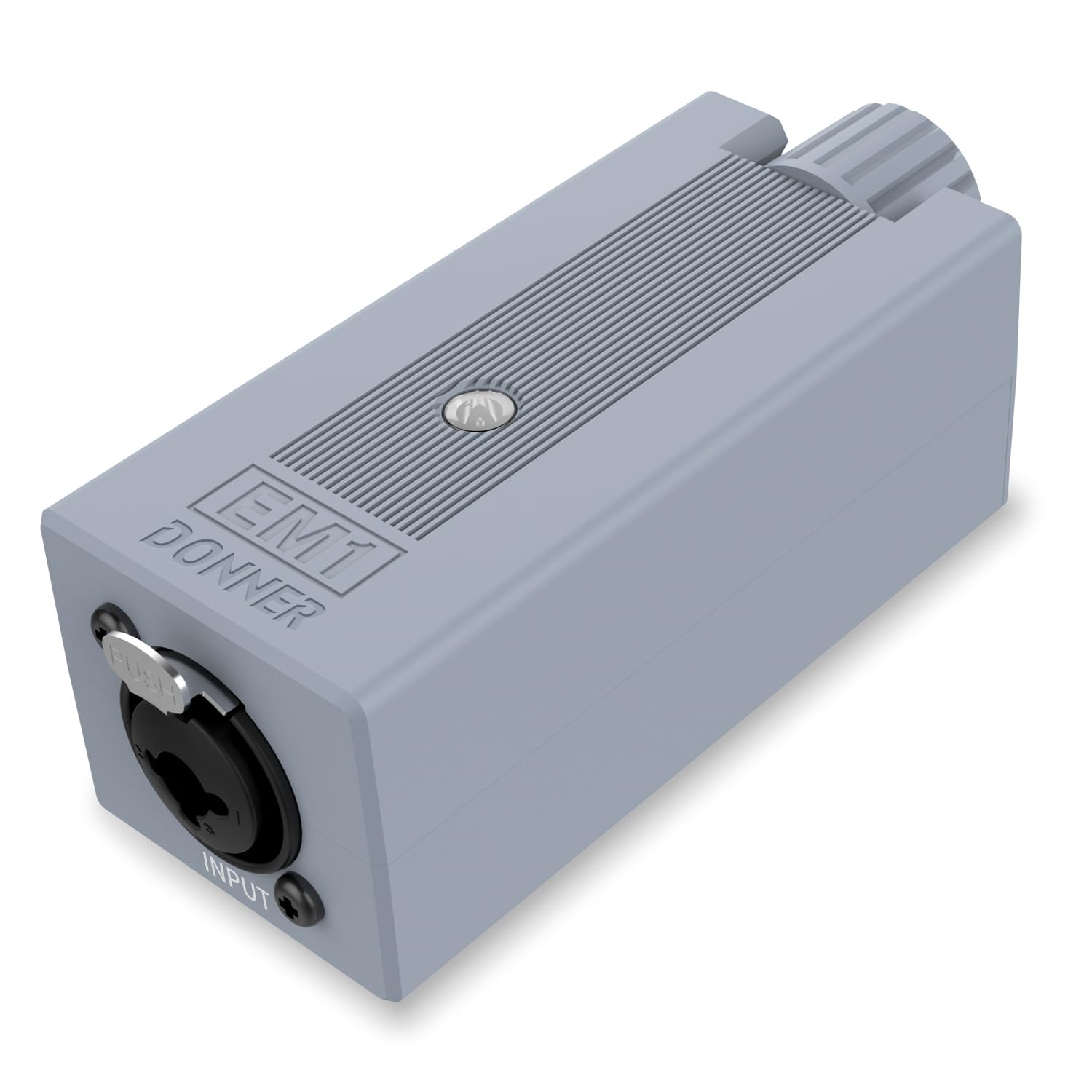
The Donner EM1 is a rechargeable personal headphone amplifier designed for in-ear monitoring, with XLR and TRS inputs and a stereo/mono source switch.
This Donner EM1 review looks at where its portable, battery-powered design fits and what to check before relying on it in your setup.
Donner EM1 Review Summary
The quick verdict
800+ ratings
Read Amazon ReviewsDonner EM1
A compact, rechargeable belt-pack amp for musicians who need personal headphone monitoring from XLR or TRS sources.
- XLR and TRS input connectors provide options for connecting compatible audio sources.
- A stereo/mono source switch lets you select a mode based on the cable connection.
- The rechargeable Li-ion battery is rated for up to 12 hours of operation.
- LED indicators provide power and battery-charging status.

Pros
- Portable belt-pack design with a solid metallic clip.
- Offers both XLR and TRS input formats.
Consider before buying
- It does not support microphones, limiting its role to headphone monitoring.
- Buyers need to confirm that their source, cable, and headphones are compatible with the EM1's input and output arrangement.
Read the full review summary
The EM1 combines a compact belt-pack format with a metallic clip, a rechargeable Li-ion battery rated for up to 12 hours, and input options for XLR and TRS connections.
Its design is aimed at personal headphone monitoring, especially when musicians need to keep a listening feed close while moving around.
Its appeal depends on matching the unit to the signal path and headphones you use.
The product description says it is suited to high-impedance professional headphones and explicitly does not support microphones, so buyers should confirm that their source connection and monitoring needs align before choosing it.
The buying factors
Donner EM1 Scorecard
Editorial scores reflect listed features and buyer fit; they are not laboratory measurements or customer ratings.
Portability
A compact design and belt-pack clip are practical for carrying a personal monitor setup.
Input flexibility
XLR and TRS inputs provide two useful connection formats, with a locking mechanism described for the input connector.
Monitoring control
A stereo/mono source switch offers a way to match the input arrangement to the connected cable.
Battery convenience
The rechargeable battery is rated for up to 12 hours, with power and charging indicators.
Headphone suitability
The design is described as high power and suitable for high-impedance professional headphones, though individual setup fit still matters.
Versatility
It is focused on headphone monitoring and does not support microphone use.
Key Features and Specifications of Donner EM1
- XLR and TRS input connectors provide options for connecting compatible audio sources.
- A stereo/mono source switch lets you select a mode based on the cable connection.
- The rechargeable Li-ion battery is rated for up to 12 hours of operation.
- LED indicators provide power and battery-charging status.
- A metallic belt-pack clip and compact form make the unit easier to carry on a performance setup.
- The high-power design is intended for high-impedance professional headphones; microphone use is not supported.
Pros and Cons of Donner EM1
Pros
- Portable belt-pack design with a solid metallic clip.
- Offers both XLR and TRS input formats.
- Stereo/mono switching can accommodate different source and cable arrangements.
- Rechargeable battery life is rated for up to 12 hours.
Consider before buying
- It does not support microphones, limiting its role to headphone monitoring.
- Buyers need to confirm that their source, cable, and headphones are compatible with the EM1's input and output arrangement.
- Battery runtime is an up-to figure, so plan charging around the length and demands of your sessions.
Who Should Buy Donner EM1?
Good fit
Consider the EM1 if you need a portable personal monitor amp that can attach to a belt or performance setup and your source provides a compatible XLR or TRS connection.
Its stereo/mono switch adds practical flexibility when the cable arrangement calls for one mode or the other.
It may suit musicians who want a rechargeable headphone amp for in-ear monitoring or professional headphones.
Before buying, check the source output, connector type, headphone requirements, and whether you need microphone support; the EM1 is not designed to handle a microphone.
Who should skip it
Skip this model if your monitoring setup requires a microphone input or you need one device to amplify both a microphone and headphones.
Look elsewhere if you cannot confirm that your source and headphones will work with its XLR/TRS input and 3.5 mm output arrangement, or if your sessions require a guaranteed runtime beyond the stated up-to figure.
Donner EM1 review: how its monitoring design fits
Inputs and source matching
XLR and TRS inputs give the EM1 two familiar connection formats, while the stereo/mono switch makes the source arrangement an important part of setup.
Check which output your mixer or other source provides and whether the cable connection calls for stereo or mono operation before a performance.
Headphone and in-ear use
The amp is positioned for personal in-ear monitoring and described as suitable for high-impedance professional headphones.
That makes headphone matching central to the purchase: check your own headphones' requirements and expected listening level rather than assuming every pair will behave the same way.
Battery and carrying
A rechargeable Li-ion battery rated for up to 12 hours supports portable use, and the LED indicators give power and charging status.
The belt-pack clip and compact design are useful when a stationary desktop amplifier would be inconvenient, though charging plans should account for the length of your sessions.
A focused role
The EM1's design centers on headphone monitoring, and microphone support is explicitly excluded.
Buyers looking for a personal listening feed can assess it on its intended role; anyone who needs a microphone path should choose equipment built for that signal as well.
Alternatives to Donner EM1
No alternative model is recommended here. Compare input connections, headphone compatibility, portability, and battery needs before choosing another option.
Is Donner EM1 Worth It?
The Donner EM1 is worth considering for musicians who want a compact, rechargeable personal headphone monitor with XLR and TRS input options, a stereo/mono switch, and a clip for portable use.
Its up-to 12-hour battery rating adds convenience for sessions away from a fixed setup.
Buy it only after checking your source connection, cable arrangement, and headphones, and keep its microphone limitation in mind.
If those needs match, the EM1 offers a focused monitoring setup; if you need microphone support or a broader signal path, choose a different type of amp.
Your review at a glance
800+ ratings
Read Amazon ReviewsDonner EM1
A compact, rechargeable belt-pack amp for musicians who need personal headphone monitoring from XLR or TRS sources.
- XLR and TRS input connectors provide options for connecting compatible audio sources.
- A stereo/mono source switch lets you select a mode based on the cable connection.
- The rechargeable Li-ion battery is rated for up to 12 hours of operation.
- LED indicators provide power and battery-charging status.